
Turning Energy Performance Certificates into Usable Portfolio Data
Energy Performance Certificates are becoming increasingly relevant for banks, asset managers, and real estate finance teams. They are no longer just static PDF documents attached somewhere in a data room. They are part of how institutions understand collateral quality, regulatory exposure, ESG performance, renovation potential, and long-term portfolio risk.
The problem is that EPC data often arrives in one of the least useful formats possible: scanned or semi-structured PDF files. For a single property, this is inconvenient. For a portfolio, it becomes an operational bottleneck as the manual review is slow and spreadsheet entry is error-prone. Document formats differ between countries and certificate types. Relevant values may be visible on the certificate, but not available as structured data. And without structured data, the information cannot easily be used for reporting, analytics, valuation workflows, risk monitoring, or system integration.
This is the gap the EcoAsset EPC processing pipeline is designed to close.
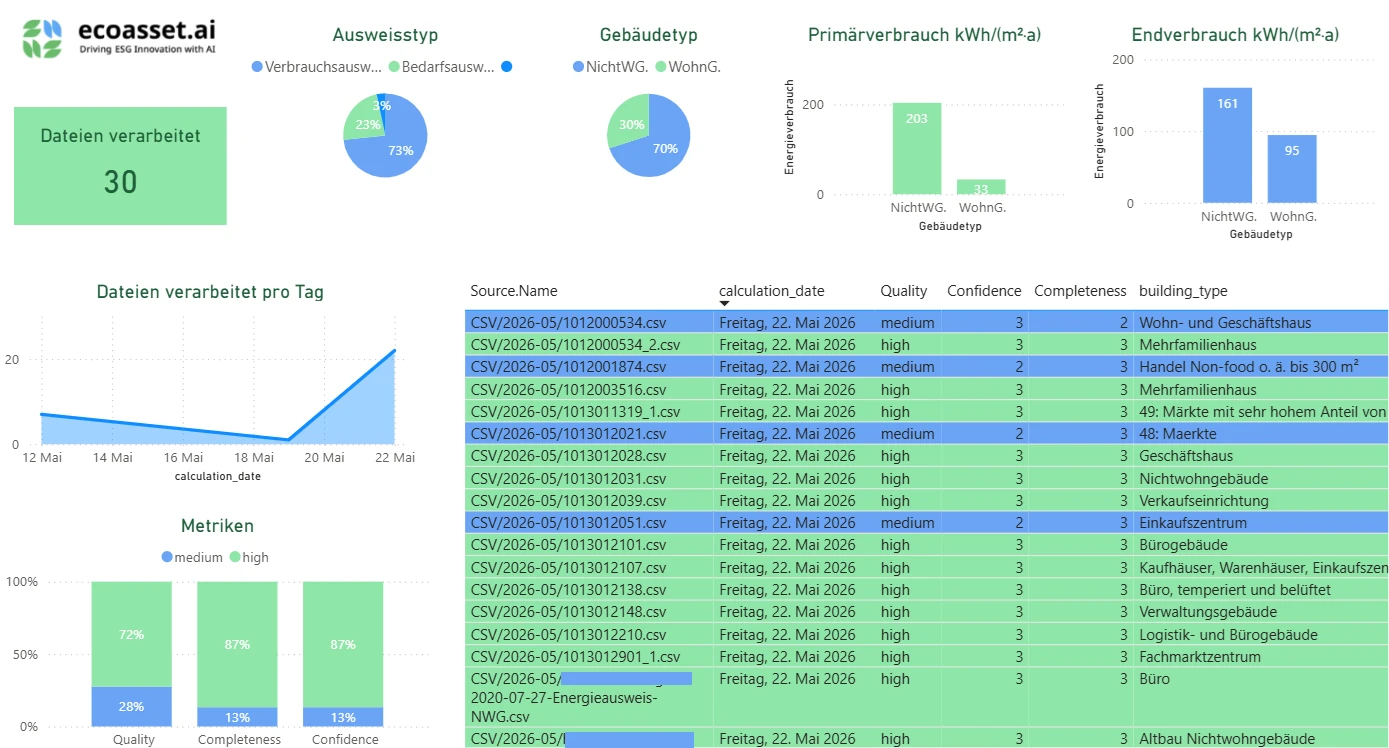
From Document Archive to Data Asset
The goal of the pipeline is straightforward: take uploaded EPC documents and convert them into structured, normalized, export-ready data.
In practical terms, the input is a PDF energy certificate, the output is a clean dataset containing the values that banking and real estate teams actually need: certificate type, registration number, issue date, validity date, building type, area, energy values, EPC subtype, quality indicators, and downstream formats such as CSV, XML, or reporting files. The value is not only that the document can be “read”. The value is that the certificate becomes usable.
Once EPC information is structured, it can be connected to portfolio systems, quality checks, collateral analysis, ESG reporting, and internal dashboards. Instead of being locked inside individual documents, the data becomes available for scalable decision-making.
How the Pipeline Works
The pipeline is built as a modular document-processing workflow. Each stage performs one clearly defined task and passes an intermediate result to the next stage.
The process starts with PDF documents uploaded into cloud storage. The first module converts each PDF page into an image representation and stores it in a machine-readable intermediate CSV format. This is important because EPCs are often visually structured documents. A model needs to see the certificate layout, not only raw text.
The next module classifies the certificate type. Different EPC formats contain different fields and labels, so the system first needs to understand what kind of document it is dealing with. The classifier uses Azure OpenAI vision capabilities to inspect the first page and assign the document to a supported certificate category.
After classification, the extractor applies the relevant ontology for that certificate type. This ontology defines which fields matter and how they should be interpreted. The extraction step then identifies the required values from the certificate image and returns structured attributes.
Finally, the harmonizer maps the extracted fields into a normalized target schema. This step is essential for business usability. Raw extraction results are useful, but harmonized outputs are what make the data comparable across documents, portfolios, and downstream systems.
The end result is not just “AI output”. It is structured EPC data that can be exported, checked, reported, and integrated.
Why This Matters for Banking
For banks, EPC data is not an isolated sustainability detail. It is connected to real financial workflows.
Energy performance can influence collateral assessment, renovation needs, portfolio transparency, regulatory reporting, and long-term asset risk. As energy efficiency becomes more relevant for real estate finance, institutions need scalable ways to work with EPC information.
The traditional approach creates friction at every step. A PDF needs to be opened. The relevant values need to be found. Someone needs to copy them into a spreadsheet or system. Another person may need to check them. If the portfolio contains hundreds or thousands of assets, the process becomes expensive, inconsistent, and difficult to audit.
The EcoAsset pipeline addresses this by making EPC data machine-readable from the beginning. This creates added value in several ways:
- It reduces manual workload. Teams no longer need to treat every EPC as a separate manual data-entry task.
- It improves consistency. The same logic is applied across documents, which reduces variation caused by different reviewers or different spreadsheet habits.
- It supports auditability. The pipeline includes validation, logging, and audit information, so processing results can be reviewed instead of disappearing into an opaque black box.
- It creates data that can be reused. Once harmonized, EPC information can feed reports, dashboards, internal systems, XML exports, or portfolio-level analysis.
- It makes the process scalable. A workflow that works for one certificate can be extended to larger document volumes without redesigning the entire process.
Not Just Extraction: Controlled Automation
A key design principle of the project is controlled automation.
The system does not simply send a document to a model and accept any response. The classifier is instructed to return only a predefined certificate class. Empty, unsupported, or malformed responses are rejected. The process writes audit information and handles errors explicitly.
This matters in a banking context because trust is not optional. For financial institutions, a data pipeline needs more than impressive AI capabilities. It needs transparency, reproducibility, and failure behavior that can be understood.
If a certificate cannot be processed confidently, this should be visible. If a document type is unsupported, the system should not pretend otherwise. If a result is incomplete, that needs to be reflected in quality information.
The goal is not to remove human oversight entirely. The goal is to reduce repetitive manual work while making exceptions easier to identify.
Built for Real-World Document Complexity
Energy certificates are not always clean, uniform, or conveniently structured. They can differ by country, certificate type, layout, terminology, and scan quality. German residential and non-residential certificates, Dutch energy labels, and other formats may require different extraction logic.
That is why the pipeline separates classification from extraction. Instead of applying one generic prompt to every document, the system first identifies the certificate type and then applies the corresponding ontology.
This makes the workflow more adaptable. New certificate types can be added by extending the classification logic and defining the relevant extraction ontology. The architecture is therefore not limited to one document template. It is designed as a framework for processing EPC-like documents in a structured way.
From ESG Checkbox to Portfolio Intelligence
Many organizations still treat EPCs as compliance documents: collect them, store them, and retrieve them when needed, but the more useful perspective is to treat EPCs as data sources.
A single certificate contains information about building efficiency, energy demand or consumption, asset category, and potentially renovation relevance. Across a portfolio, this becomes a dataset that can support segmentation, monitoring, reporting, and strategic planning.
- Which assets have weak energy performance?
- Which certificates are close to expiry?
- Which buildings may require additional review?
- Where are values missing or inconsistent?
- Which parts of the portfolio have strong enough data quality for confident reporting?
These are not PDF questions, they are data questions. The EcoAsset pipeline makes those questions easier to answer.
The Added Value
The product is useful because it turns unstructured EPC documentation into structured portfolio intelligence. For banking and real estate finance teams, this means:
- Less manual document review.
- Faster onboarding of EPC data.
- More consistent extraction of relevant values.
- Clearer quality and audit information.
- Better integration into downstream systems.
- A stronger basis for ESG, collateral, and portfolio analysis.
In other words, the pipeline helps move EPC processing from document administration to data infrastructure. That shift is where the real value lies.
Conclusion
Banks do not need more PDFs. They need reliable, structured, usable data. Energy Performance Certificates already contain information that matters for real estate finance, ESG transparency, and portfolio risk. The challenge is making that information accessible at scale.
The EcoAsset EPC processing pipeline solves this by converting uploaded certificates into classified, extracted, harmonized, and export-ready data. It combines cloud-based processing, Azure OpenAI vision capabilities, ontology-driven extraction, validation, and downstream output generation.
The result is a practical bridge between document-heavy real estate workflows and data-driven banking decisions. EPCs stop being passive files, they become actionable portfolio data.